Sleep in Later Life: Why the Circadian Rhythm Changes and How to Improve It
14/11/2026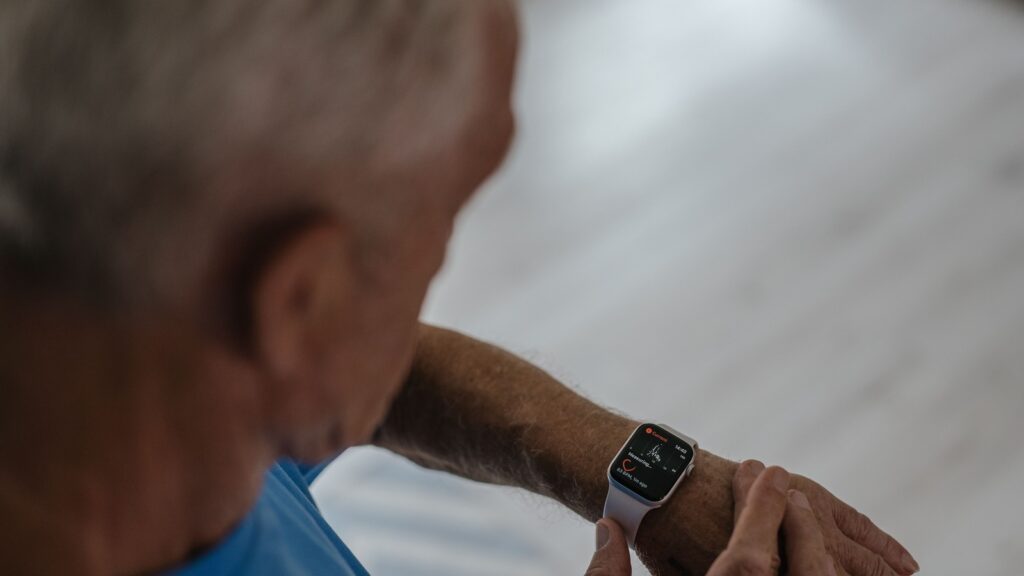
Elderly care technology has entered our homes more quietly than we think. A daughter gives her father a smartwatch. A grandson sets a pill reminder on his grandmother’s phone. Suddenly, everyone is talking about artificial intelligence and “smart” devices. Which of these really help? And where do we need to be careful? In this article we put things in order, based on the scientific evidence.
What we mean by elderly care technology
By this term we mean any device or app that supports an older person, that is, their safety, health and independence. A few examples:
- Wearable devices (wearables): smartwatches, bracelets and pendants with an emergency button.
- Sensors in the home: motion detectors, door sensors, smart lighting.
- Apps: medication reminders, video calls, voice assistants.
- AI-based systems: software that “learns” a person’s routine and flags changes.
The idea is not new. The U.S. National Institute on Aging (NIA) has recommended medical alert systems for years. The person wears a small device, so if they fall, get lost or need help, it alerts someone straight away. The difference today is that these devices have become smaller, cheaper and “smarter”.
Smartwatches and fall detection
A fall is every family’s biggest fear. According to the World Health Organization, the risk rises when balance, strength or eyesight weaken. What is more, after a fall many older people cannot get up on their own. The sooner help arrives, the better.
This is where technology has real value. Many watches and pendants have sensors that detect a sudden fall. If the wearer does not respond, they automatically call a relative or an assistance service.
However, they are not infallible. A review of systematic reviews found good accuracy in laboratory tests. It noted, though, that studies on frail older adults in real life are lacking. It also stressed that false alarms need to be reduced. Otherwise, the family grows tired of them and starts to ignore them.
There is also a simpler problem. The watch only helps when it is being worn. For example, a lady who takes it off to have a bath is unprotected in exactly the most dangerous spot in the house. That is why the device complements fall prevention at home; it does not replace it.
Heart, sleep and steps: useful data, not a diagnosis
Modern watches measure heart rate, steps and hours of sleep. Some also record a single-lead electrocardiogram. In this way, they can reveal an irregular rhythm, as in atrial fibrillation.
A calm approach is needed, however. The 2024 guidelines of the European Society of Cardiology are clear. An alert from a watch is not enough for a diagnosis. An electrocardiogram recording is needed, reviewed by a doctor. Measurements based only on the sensor’s light are not sufficient.
The same applies to sleep. The watch gives an estimate, not a test. If your parent sleeps badly, see our guide to sleep disorders in older adults. Then talk to the doctor. Even so, the device’s data can support a meaningful conversation at the surgery.
Where artificial intelligence comes in
Many people imagine a robot looking after grandad. In elderly care technology, however, artificial intelligence is something simpler. In practice, it is software that analyses large amounts of data and spots patterns. For example, a sensor system “learns” that your mother gets up at seven every morning. If one day she has not moved by ten, it sends a message.
Similarly, more frequent night-time trips to the toilet can be an early signal. The cause might be a urinary tract infection, a new medication or something else. The device, though, does not know which of these it is. It simply tells us that something has changed and is worth checking.
Voice assistants also make life easier. Grandma asks to listen to the radio or to call her daughter, without hunting for buttons. For someone who lives alone, that is no small thing.
Privacy, dignity and consent
Every device that records also collects personal health data. The World Health Organization calls for artificial intelligence in health to respect people’s autonomy and privacy. In a separate report, the same organisation warns about ageism in artificial intelligence. Older people are often missing from the data on which these systems are “trained”. As a result, the tools do not always work as well for them.
In everyday life, this means something simple. We ask the person first. A camera in the living room may reassure us, but they may feel watched. In dementia, the decision is made together with the family and the doctor, always with respect for the person’s dignity.
How to choose a device for your parent
Before you buy, think about which problem you want to solve. A few practical questions:
- Is it simple? Large text, few buttons, clear sound.
- Will they wear it? If it is heavy or uncomfortable, it will stay in the drawer.
- Is it water-resistant? The bathroom is one of the most dangerous places for a fall.
- How long does the battery last? A device that needs charging every night is often left forgotten on the counter.
- Who receives the alert? A relative, an assistance centre, or both?
- Where does the data go? Read the privacy policy and ask about GDPR.
Finally, do not expect miracles. Elderly care technology only succeeds when it fits the person’s needs. The best device is the one your parent understands and uses every day. When care at home becomes too heavy, our guide to choosing an elderly care facility will help you. And do not forget yourself: caregiver burnout is very common.
Technology and human care at DELFINI
At the DELFINI Gerontological Centre in Glyfada, we see technology as an assistant. An alert can buy precious time. But nothing replaces a smile, a chat and the experienced eye of a nurse. For us, good elderly care technology gives staff more time for the person.
Frequently asked questions
Is a smartwatch with fall detection worth it?
It can help, especially for people who live alone. However, it does not detect every fall and it also gives false alarms. It also only protects when it is being worn.
Can a watch diagnose atrial fibrillation?
Not on its own. An alert about an irregular rhythm needs to be confirmed with an electrocardiogram, reviewed by a doctor.
Is the personal data from these devices safe?
It depends on the company. Before buying, check where the company stores the data and who can see it. Also, always ask for the older person’s own consent.
Can elderly care technology replace the caregiver?
No. Technology alerts and reminds, but it does not care. Human presence remains irreplaceable.
This article is for information only and does not replace medical advice. For any health matter, consult your doctor. For information about care at DELFINI, contact us.