Early Signs of Dementia: When Memory Loss Is Something More
22/09/2026
Senolytic Drugs, Ageing and Cellular Renewal
29/09/2026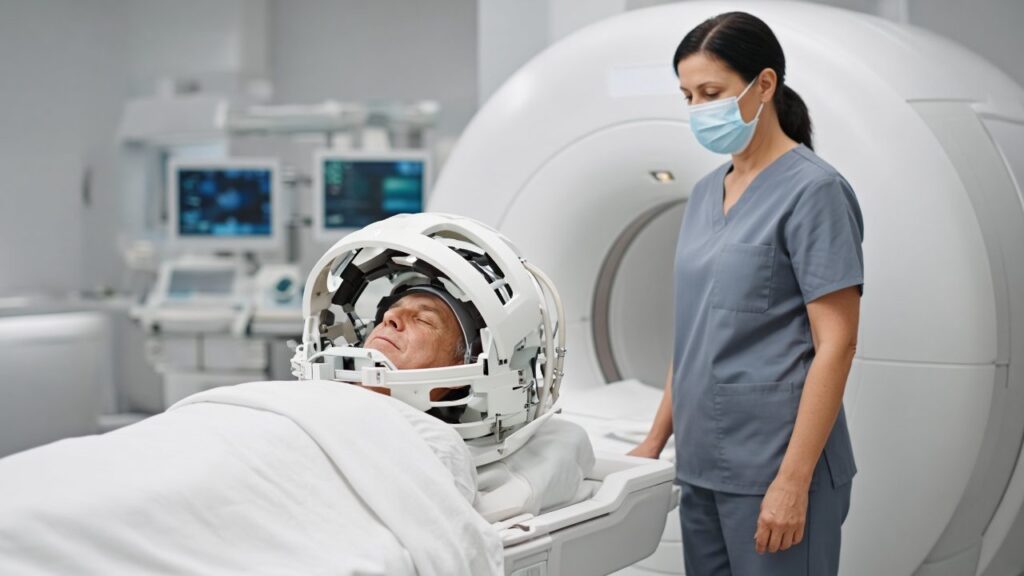
MRI-guided focused ultrasound (MRgFUS) is a tremor treatment that needs no opening in the skull. It is for people with essential tremor or tremor from Parkinson’s disease, when medicines do not help enough. For many older people, a shaking hand makes eating, writing or doing up buttons hard. This guide explains what the method offers, where its limits lie and who it suits.
Tremor in older age
Essential tremor is one of the most common movement disorders in older adults. It shows mainly when the hand moves or holds something, such as a glass. In Parkinson’s disease, tremor is usually worse at rest and comes with other symptoms, such as slowness and stiffness.
Tremor does not threaten life directly. It does, however, strongly affect independence, confidence and social life. Many people avoid eating out or signing their name in front of others. Medicines are the first treatment. When they do not help enough or cause side effects, the neurologist looks at procedures.
How focused ultrasound works
The method combines an MRI scanner and a special helmet with more than a thousand ultrasound sources. The beams pass through the skull and meet at a tiny point in the thalamus, deep in the brain. A circuit there carries the tremor signal. Heat at the focal point creates a small, permanent lesion that interrupts this signal.
The MRI shows the target and the temperature in real time. Before the final heating, doctors give low test doses to confirm the position. This check improves accuracy, but it does not remove the risk of side effects.
The treatment step by step
- The team shaves the scalp and fits a fixed head frame under local anaesthetic.
- The patient lies in the scanner, awake, wearing the ultrasound helmet.
- The team gives short ultrasound pulses and checks the hand after each one, for example with a spiral drawing.
- The session usually takes two to four hours. Many patients go home the same or the next day.
During treatment you may feel heat, headache, dizziness or nausea. These usually pass as soon as each pulse stops.
Results and risks of focused ultrasound
In studies of essential tremor, tremor in the treated hand fell markedly, often at once. In many patients the benefit lasted for years, although it can fade over time. The improvement affects one side of the body.
Possible side effects include:
- numbness or tingling in the fingers or lips.
- unsteady walking.
- weakness or speech problems, more rarely.
Most of these settle within weeks or months. In a small share of patients, though, they remain. Because the method does not open the skull, the risk of infection and bleeding is low, but not zero. The brain lesion is permanent, and the doctor cannot adjust it later.
Who is a suitable candidate?
A specialist team of neurologists and neurosurgeons makes the decision. They usually consider:
- whether tremor seriously affects daily life despite medicines.
- skull bone density on a CT scan, because it decides whether the ultrasound can reach the target.
- whether the patient can have an MRI and lie still for hours.
- memory, balance and other illnesses.
The UK body NICE has assessed one-sided treatment for essential tremor that does not respond to medicines. In some countries, treating the second side has approval only after at least nine months, and only for selected patients with essential tremor.
Focused ultrasound or deep brain stimulation?
In Parkinson’s disease, focused ultrasound mainly reduces tremor. It does not stop the disease from progressing, and it does not improve slowness or walking. Deep brain stimulation (DBS) needs surgery and an implant. It can, however, help more symptoms, work on both sides and stay adjustable over the years. Read more in our article on Parkinson’s disease and deep brain stimulation from ΔΕΛΦΙΝΙ.
After any treatment, occupational therapy and physiotherapy support safe movement. If balance is a problem, see our guide to fall prevention at home on our blog. At ΔΕΛΦΙΝΙ, medical follow-up includes work with the treating neurologist and close attention to balance and falls.
What to ask the neurologist
Before deciding, write down your questions and bring a family member. Useful questions include:
- Have we tried all suitable medicines, at the right dose?
- What benefit do you expect for my hand, and for how long?
- Which side effects do you see most often at your centre?
- Would deep brain stimulation suit me better?
- What does it cost, and what does insurance cover?
The answers help the family make a calm decision with realistic expectations.
Frequently asked questions
Does focused ultrasound treatment hurt?
There is no incision. During treatment you may feel heat, headache or dizziness, which usually pass as soon as each pulse stops.
How quickly does the tremor improve?
Often at once, inside the scanner. The doctor judges the final result after a few weeks, once the swelling around the treated spot settles.
Does focused ultrasound cure Parkinson’s disease?
No. It reduces tremor on one side, but it does not stop the disease from progressing, and it does not improve slowness or walking.
Can both hands have treatment?
Doctors usually treat the hand that causes more trouble first. In some countries, selected patients with essential tremor can have the second side treated after at least nine months.
For personal advice about your relative, please contact us and we will get back to you.